Absolute Value Inequalities
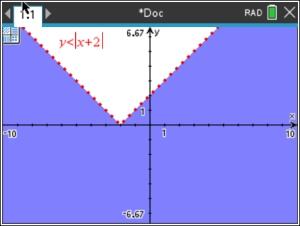
Example 1: Graph: y < | x + 2 | Inequalities. such as this, are graphed as "relations"
|
|
|
 |
||
 to erase the "=" sign.


 #1 Action, #5 Set Conditions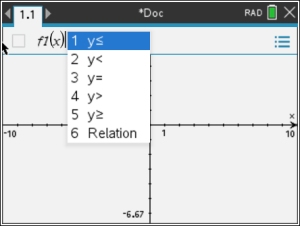
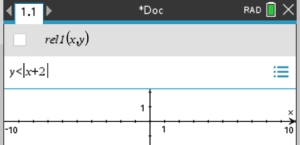
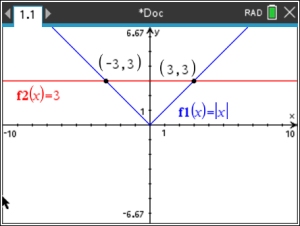
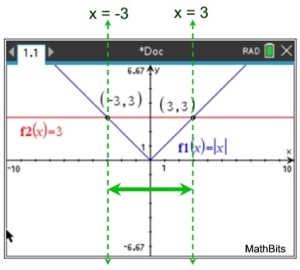
| Example 2: Solve: | x | < 3 Unfortunately, the TI-Nspire CX II non-CAS will not graph and shade inequalities that do not contain both an "x" and a "y" value (such as Example 1). The best this calculator can do is show us where the left and right sides of this inequality intersect. We can then "look" at the graph to see for which x-values the sections are "above" or "below" each other (depending upon the inequality).
|
|
|
|
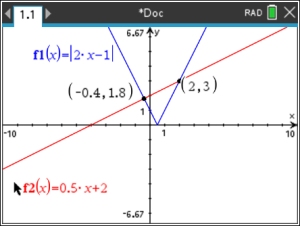
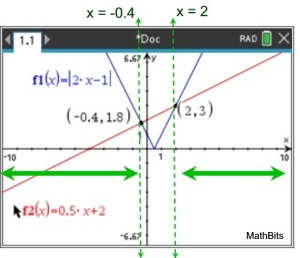
Example 3: Solve: | 2x - 1 | > 0.5x + 2 Follow the same steps as Example 2. In this problem, we are looking for x-values for which the absolute value will be "above" or "on" (greater than or equal to) the red line. For the x-values that are "above or on" to the right and to the left of the two intersection locations, including the intersection points themselves, will make the absolute value greater than the linear equation. • Answer: (-∞, -0.4] U [2,∞) |
  |
|
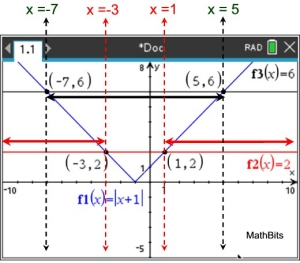
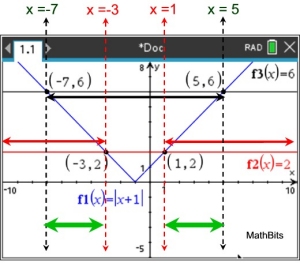
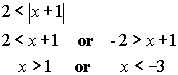
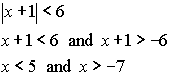
Example 4: Solve:  From the algebraic solution, we know that this is a "two part" type of problem (a compound inequality). Algebraic solution: |
|
Calculator solution: • For the left hand portion: find the x-values for which the absolute value is "above" (greater than) 2. • For the right hand portion: find the x-values for which the absolute value is "below" (less than) 6. • Find where these two solutions overlap one another |
Answer: -7 < x < -3 or 1 < x < 5. |
 .
.